Resources
As educators, we can help support learners with the tools and supports they need to be successful. This page contains the resources you need to make this happen.
Publications
Trauma-informed Pedagogical Practices in Post-Secondary Education: An Integrative Review of the Literature
VanderKaay, S., Begin, D., Jack, S., Lisogurski, R., Robb, C., Phoenix, M., & Vrkljan, B. (2025). Trauma-informed pedagogical practices in post-secondary education: An integrative review of the literature. The Canadian Journal for the Scholarship of Teaching and Learning, 16(1). https://doi.org/10.5206/cjsotlrcacea.2025.1.17123
Trauma-Informed Pedagogy: The Prevalence of Trauma Among Students in a Master of Science Program in Occupational Therapy
Wilson, A., Chen, R., Phoenix, M. P., Wojkowski, S., & VanderKaay, S. (2024). Trauma-informed pedagogy: The prevalence of trauma among students in a Master of Science program in occupational therapy. Journal of Occupational Therapy Education, 8(4). https://encompass.eku.edu/jote/vol8/iss4/4
As instructors, we have a passion for teaching and learning but may never understand what every student brings into the classroom and the challenges they face before learning can happen. Trauma manifests in many ways. An integrative review of the literature was originally completed via an IDEAS grant using a framework put forth by Shevrin-Venet (2021)2. The framework resulted is presented in a simplified form in the form of an info-graphic. Below are just a few strategies from each of the four main priority areas.
Connection
Trauma-informed pedagogical strategies to promote connection can be understood as those that involve cultivating healthy relationships with students, and fostering healthy relationships among students, and others. Strategies that promote a sense of belonging for all within learning spaces are central to cultivating connection.
Interactions/Relationships:
- Make sure your students know how to reach you, and what they can expect in terms of response time. Where possible, provide both text-based and verbal options for connection.
- Reach out to check on students who seem to be struggling in (or absent from) your course. Ask them if there’s anything they need to help them succeed in the course, and follow-up with campus referrals or resources when warranted.
- Incorporate brief well-being activities into your class.
Academic/Pedagogical:
- Connect care, empathy, and well-being to your course objectives or content. You can highlight those connections for students in a way that works for your subject.
- Implement informal communication at the start of class as it can create a sense of community which promotes learning.
- Create a classroom that is welcoming to personal dialogue in which students can choose to approach, explore, discuss, and narrate the trauma of their lives.
System/Policy/School-Wide:
- Establish policies and processes that reinforce cultural competence.
- With students’ permission, faculty members can update one another on student situations and then work to address needs.
- Assume holidays are not always a happy time for everyone. Students might be on their own without food or activities to take part in. Residence hall meal plans may not work well over the break and students may be short on money to take care of themselves or to do activities. They may be afraid to reach out, not wanting to be a burden. Arrange or provide opportunities for students to be welcomed somewhere over the holidays.
Empowerment
Trauma-informed pedagogical strategies associated with empowerment involve cultivating and supporting students’ agency and autonomy and building student confidence. Empowerment strategies necessarily require opportunities for students to enact their own power control over their learning when possible.
Interactions/Relationships:
- List campus support resources in the syllabus and through course announcements. Do not assume that students have knowledge of any available resources.
- Express belief in your students’ potential for continued learning and development.
- Help students explore, identify, and apply their strengths.
Academic/Pedagogical:
- Ask students to reflect on their own work and progress, thinking about their approach to work in the course, and how they might need to adjust their strategies to find success.
- Emphasize learning and developing proficiency rather than performing well. If a student wants to improve on a test score, for example, talk through what the score represents in terms of their journey toward proficiency and content mastery, rather than the grade itself.
- Highlight the long-term implications of the course goals and skills, such as how students might incorporate them in future careers or interpersonal relationships.
System/Policy/School-Wide:
- Use multicultural promotional literature.
- Provide many co curricular or extracurricular opportunities for the at-risk student.
- Educational programs and policies that understand the effects of chronic stress and promote resilience may be able to contribute to student success.
Predictability
Trauma-informed pedagogical strategies aimed at promoting predictability involve arranging learning environments so that students clearly know what to foresee and expect, there are minimal surprises, and everyone is on the same page. Predictability strategies require anticipating circumstances and situations that might feel triggering for students and finding ways to proactively ensure safety in learning.
Interactions/Relationships:
- Create a sense of physical safety in your physical space.
- Consider providing the following information at the beginning of the semester to help students feel more prepared and more comfortable:
- locations of entrances and exits.
- emergency procedures specific to your classroom.
- locations of gender-neutral bathrooms and nearby water fountains.
- your commitment to meeting students’ needs in terms of classroom accessibility.
- your expectations for the space (e.g., whether students should ask you before leaving the room).
- Consider increasing your own personal transparency (to the extent you are comfortable). For example, if you miss a class you might explain to students where you are going.
Academic/Pedagogical:
- Be explicit about changes to routine and give notice in advance of major changes.
- Format similar activities in similar ways and (where possible) use the same or similar criteria or rubrics for assessing work.
- Provide timely feedback and communicate with students about their progress.
System/Policy/School-Wide:
- Ensure program emergency plans are updated and made available to faculty and students.
Flexibility
Trauma-informed pedagogical strategies aimed at promoting flexibility are those that focus on prioritizing the most important aspect of the learning and relinquishing less important aspects as needed. Flexibility strategies allow for ‘doing things differently’ when the actual learning is prioritized over the standardized processes.
Interactions/Relationships:
- Be patient and offer resources, while accepting that a student may not be ready to engage in the resources you have offered. Many students feel “forced” into treatment and they may need space and time to feel empowered about their decision to engage in formal mental health services.
- Imagine how instability, homelessness, or lack of food or money may impact one’s ability to concentrate in class and complete readings and assignments on time.
- Allow learners to share as much or as little information about themselves as they choose.
Academic/Pedagogical:
- Build flexibility into deadlines and course expectations, thereby giving students an “out” to deal with arising difficulties. For example, you might allow for a certain number of non-penalized “late days” where no explanation is required.
- Consider requests for extensions or re-submission of completed work, combined with compassion for the difficulties students might be managing in their personal lives.
- Adjust curriculum plans or modify your course schedule in the case of a significant event on campus or in the surrounding community.
System/Policy/School-Wide:
- Include a policy of leaves of absence for “family reasons” to give learners the time they need to deal with issues outside of the classroom until they feel ready to take on learning again.
- Provide a space in the classroom or another room to which learners may retreat as needed.
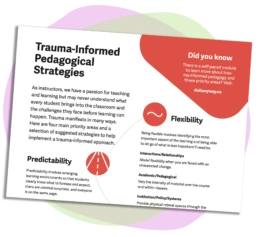
Download your complete version of the trauma-informed resource with over 50 strategies to help you understand and implement a trauma-informed approach.
EMPOWERMENT
Trauma-informed pedagogical strategies associated with empowerment involve cultivating and supporting students’ agency and autonomy and building student confidence. Empowerment strategies necessarily require opportunities for students to enact their own power control over their learning when possible.
Interactions/Relationships:
- List campus support resources in the syllabus and through course announcements. Do not assume that students have knowledge of any available resources.
- Express belief in your students’ potential for continued learning and development.
- Help students explore, identify, and apply their strengths.
Academic/Pedagogical:
- Ask students to reflect on their own work and progress, thinking about their approach to work in the course, and how they might need to adjust their strategies to find success.
- Emphasize learning and developing proficiency rather than performing well. If a student wants to improve on a test score, for example, talk through what the score represents in terms of their journey toward proficiency and content mastery, rather than the grade itself.
- Highlight the long-term implications of the course goals and skills, such as how students might incorporate them in future careers or interpersonal relationships.
System/Policy/School-Wide:
- Use multicultural promotional literature.
- Provide many co curricular or extracurricular opportunities for the at-risk student.
- Educational programs and policies that understand the effects of chronic stress and promote resilience may be able to contribute to student success.
FLEXIBILITY
Trauma-informed pedagogical strategies aimed at promoting flexibility are those that focus on prioritizing the most important aspect of the learning and relinquishing less important aspects as needed. Flexibility strategies allow for ‘doing things differently’ when the actual learning is prioritized over the standardized processes.
Interactions/Relationships:
- Be patient and offer resources, while accepting that a student may not be ready to engage in the resources you have offered. Many students feel “forced” into treatment and they may need space and time to feel empowered about their decision to engage in formal mental health services.
- Imagine how instability, homelessness, or lack of food or money may impact one’s ability to concentrate in class and complete readings and assignments on time.
- Allow learners to share as much or as little information about themselves as they choose.
Academic/Pedagogical:
- Build flexibility into deadlines and course expectations, thereby giving students an “out” to deal with arising difficulties. For example, you might allow for a certain number of non-penalized “late days” where no explanation is required.
- Consider requests for extensions or re-submission of completed work, combined with compassion for the difficulties students might be managing in their personal lives.
- Adjust curriculum plans or modify your course schedule in the case of a significant event on campus or in the surrounding community.
System/Policy/School-Wide:
- Include a policy of leaves of absence for “family reasons” to give learners the time they need to deal with issues outside of the classroom until they feel ready to take on learning again.
- Provide a space in the classroom or another room to which learners may retreat as needed.
PREDICTABILITY
Trauma-informed pedagogical strategies aimed at promoting predictability involve arranging learning environments so that students clearly know what to foresee and expect, there are minimal surprises, and everyone is on the same page. Predictability strategies require anticipating circumstances and situations that might feel triggering for students and finding ways to proactively ensure safety in learning.
Interactions/Relationships:
- Create a sense of physical safety in your physical space.
- Consider providing the following information at the beginning of the semester to help students feel more prepared and more comfortable:
- locations of entrances and exits.
- emergency procedures specific to your classroom.
- locations of gender-neutral bathrooms and nearby water fountains.
- your commitment to meeting students’ needs in terms of classroom accessibility.
- your expectations for the space (e.g., whether students should ask you before leaving the room).
- Consider increasing your own personal transparency (to the extent you are comfortable). For example, if you miss a class you might explain to students where you are going.
Academic/Pedagogical:
- Be explicit about changes to routine and give notice in advance of major changes.
- Format similar activities in similar ways and (where possible) use the same or similar criteria or rubrics for assessing work.
- Provide timely feedback and communicate with students about their progress.
System/Policy/School-Wide:
- Ensure program emergency plans are updated and made available to faculty and students.
Shipping & Returns
We offer a next working day delivery for orders placed before 6:30 p.m. Monday to Friday. Orders placed after this will be delivered within two working days. This excludes Saturday, Sunday and public holidays.
The returned product(s) must be in the original packaging, safety wrapped, undamaged and unworn. This means that the item(s) must be safely packed in a carton box for protection during transport, possibly the same carton used to ship to you as a customer.
| Destination | Delivery | Above $50 |
|---|---|---|
| Denmark | 1 – 2 days | Free |
| Belgium, Germany, Netherlands, Sweden | 2 – 4 days | Free |
| Austria, Czech Republic, Finland, France, Italy, Spain, Hungary, Ireland, Poland, Portugal, Slovakia, Slovenia | 3 – 5 days | Free |
| United States | 1 – 2 days | Free |
| Japan | 3 – 5 days | Free |
| Australia | 2 – 4 days | Free |
CONNECTION
Trauma-informed pedagogical strategies to promote connection can be understood as those that involve cultivating healthy relationships with students, and fostering healthy relationships among students, and others. Strategies that promote a sense of belonging for all within learning spaces are central to cultivating connection.
Interactions/Relationships:
- Make sure your students know how to reach you, and what they can expect in terms of response time. Where possible, provide both text-based and verbal options for connection.
- Reach out to check on students who seem to be struggling in (or absent from) your course. Ask them if there’s anything they need to help them succeed in the course, and follow-up with campus referrals or resources when warranted.
- Incorporate brief well-being activities into your class.
Academic/Pedagogical:
- Connect care, empathy, and well-being to your course objectives or content. You can highlight those connections for students in a way that works for your subject.
- Implement informal communication at the start of class as it can create a sense of community which promotes learning.
- Create a classroom that is welcoming to personal dialogue in which students can choose to approach, explore, discuss, and narrate the trauma of their lives.
System/Policy/School-Wide:
- Establish policies and processes that reinforce cultural competence.
- With students’ permission, faculty members can update one another on student situations and then work to address needs.
- Assume holidays are not always a happy time for everyone. Students might be on their own without food or activities to take part in. Residence hall meal plans may not work well over the break and students may be short on money to take care of themselves or to do activities. They may be afraid to reach out, not wanting to be a burden. Arrange or provide opportunities for students to be welcomed somewhere over the holidays.
EMPOWERMENT
Trauma-informed pedagogical strategies associated with empowerment involve cultivating and supporting students’ agency and autonomy and building student confidence. Empowerment strategies necessarily require opportunities for students to enact their own power control over their learning when possible.
Interactions/Relationships:
- List campus support resources in the syllabus and through course announcements. Do not assume that students have knowledge of any available resources.
- Express belief in your students’ potential for continued learning and development.
- Help students explore, identify, and apply their strengths.
Academic/Pedagogical:
- Ask students to reflect on their own work and progress, thinking about their approach to work in the course, and how they might need to adjust their strategies to find success.
- Emphasize learning and developing proficiency rather than performing well. If a student wants to improve on a test score, for example, talk through what the score represents in terms of their journey toward proficiency and content mastery, rather than the grade itself.
- Highlight the long-term implications of the course goals and skills, such as how students might incorporate them in future careers or interpersonal relationships.
System/Policy/School-Wide:
- Use multicultural promotional literature.
- Provide many co curricular or extracurricular opportunities for the at-risk student.
- Educational programs and policies that understand the effects of chronic stress and promote resilience may be able to contribute to student success.
FLEXIBILITY
Trauma-informed pedagogical strategies aimed at promoting flexibility are those that focus on prioritizing the most important aspect of the learning and relinquishing less important aspects as needed. Flexibility strategies allow for ‘doing things differently’ when the actual learning is prioritized over the standardized processes.
Interactions/Relationships:
- Be patient and offer resources, while accepting that a student may not be ready to engage in the resources you have offered. Many students feel “forced” into treatment and they may need space and time to feel empowered about their decision to engage in formal mental health services.
- Imagine how instability, homelessness, or lack of food or money may impact one’s ability to concentrate in class and complete readings and assignments on time.
- Allow learners to share as much or as little information about themselves as they choose.
Academic/Pedagogical:
- Build flexibility into deadlines and course expectations, thereby giving students an “out” to deal with arising difficulties. For example, you might allow for a certain number of non-penalized “late days” where no explanation is required.
- Consider requests for extensions or re-submission of completed work, combined with compassion for the difficulties students might be managing in their personal lives.
- Adjust curriculum plans or modify your course schedule in the case of a significant event on campus or in the surrounding community.
System/Policy/School-Wide:
- Include a policy of leaves of absence for “family reasons” to give learners the time they need to deal with issues outside of the classroom until they feel ready to take on learning again.
- Provide a space in the classroom or another room to which learners may retreat as needed.
PREDICTABILITY
Trauma-informed pedagogical strategies aimed at promoting predictability involve arranging learning environments so that students clearly know what to foresee and expect, there are minimal surprises, and everyone is on the same page. Predictability strategies require anticipating circumstances and situations that might feel triggering for students and finding ways to proactively ensure safety in learning.
Interactions/Relationships:
- Create a sense of physical safety in your physical space.
- Consider providing the following information at the beginning of the semester to help students feel more prepared and more comfortable:
- locations of entrances and exits.
- emergency procedures specific to your classroom.
- locations of gender-neutral bathrooms and nearby water fountains.
- your commitment to meeting students’ needs in terms of classroom accessibility.
- your expectations for the space (e.g., whether students should ask you before leaving the room).
- Consider increasing your own personal transparency (to the extent you are comfortable). For example, if you miss a class you might explain to students where you are going.
Academic/Pedagogical:
- Be explicit about changes to routine and give notice in advance of major changes.
- Format similar activities in similar ways and (where possible) use the same or similar criteria or rubrics for assessing work.
- Provide timely feedback and communicate with students about their progress.
System/Policy/School-Wide:
- Ensure program emergency plans are updated and made available to faculty and students.
Download your complete version of the trauma-informed resource with over 50 strategies to help you understand and implement a trauma-informed approach.
This resource shares the research of Dr. Sandra VanderKaay, McMaster University, to support educators in implementing trauma-informed pedagogy. This research was made possible through an IDEAS grant and a Fellowship in Teaching and Learning from MacPherson Institute with support from the School of Rehabilitation Sciences and the Faculty of Health Sciences.